Pakistan has confirmed that negotiations between the United States and Iran are continuing despite renewed tensions in the Middle East, with Islamabad saying it is making every effort to restore full implementation of the Islamabad Memorandum of Understanding (MOU).
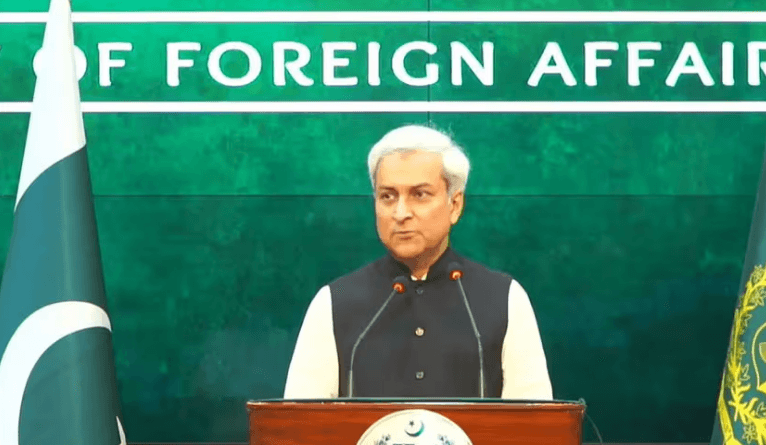
Speaking at the Foreign Office's weekly media briefing, spokesperson Tahir Andrabi said Pakistan remained deeply concerned about the deteriorating security situation in West Asia.
"After a few days of peace, the situation has once again become volatile," Andrabi said, urging all parties to pursue dialogue instead of confrontation.
He said negotiations between the United States and Iran were continuing, particularly on de-escalation efforts and the situation in the Strait of Hormuz.
"We are doing our utmost to bring all parties back to the Islamabad MOU," Andrabi said, adding that Pakistan was encouraging both sides to fully adhere to their commitments and resume technical talks under the agreement.
Diplomatic engagement continues
The spokesperson said Prime Minister Shehbaz Sharif had held discussions with Saudi Crown Prince Mohammed bin Salman on regional developments, while Deputy Prime Minister and Foreign Minister Ishaq Dar also remained in close contact with Saudi Foreign Minister Prince Faisal bin Farhan.
He added that the recent visit of Kuwait's foreign minister was significant for both bilateral ties and regional diplomacy, with Pakistan and Kuwait agreeing to enhance cooperation in several sectors.
Andrabi also said the deputy prime minister attended the Shanghai Cooperation Organisation (SCO) meeting in Kyrgyzstan, where he held a series of bilateral meetings, including discussions with a visiting US congressional delegation.
Pakistan condemns attacks on Saudi Arabia
The Foreign Office condemned attacks by non-state actors on Saudi Arabia, reiterating that Riyadh has the right to defend itself.
Andrabi described the security situation in the Gulf, the Strait of Hormuz and the Red Sea as worrying and expressed hope that diplomatic efforts would reduce tensions.
He also noted that eight Arab and Islamic countries, including Pakistan, had issued a joint statement on the regional situation.
Nuclear programme and Kashmir
The spokesperson rejected a documentary aired by a German broadcaster, alleging it contained misleading claims about Pakistan's nuclear programme.
He said Pakistan had complete confidence in its nuclear command and control system, describing it as fully aligned with international standards, and urged the broadcaster to uphold basic journalistic principles.
On Kashmir, Andrabi said Pakistan continued to reject attempts to normalise India's control over the disputed territory, adding that the use of pellet guns against civilians remained condemnable.
Regional and bilateral issues
The spokesperson confirmed that Pakistan would invite all member states, including India, to next year's SCO summit in its capacity as host.
He also said defence cooperation agreements with Kuwait, Saudi Arabia, Jordan and Bahrain were consistent with Pakistan's diplomatic role and did not contradict its efforts to mediate regional disputes.
Addressing Afghanistan, Andrabi rejected allegations of civilian casualties resulting from Pakistani operations, saying security forces targeted only terrorists, their hideouts and facilitators.
He also maintained that Pakistan had not deported Afghan nationals possessing valid legal documents.







Responses (0)